
Series: The Evolution of Enterprise Systems
How organizations are structured has never been static. Each era of business has produced its own operating model, from industrial command hierarchies to process-optimized enterprises, from agile networks to employee-centric organizations.
Today, a new shift is emerging. Advances in data, AI, and digital connectivity are pushing enterprises toward systems of distributed intelligence, where decision-making moves closer to the edge while remaining connected through shared context and governance.
This series explores how enterprise systems have evolved, why each model emerged, and what the next generation of organizations may need to look like in an increasingly complex and AI-enabled world.
Are most companies even capable of becoming “Octopus Organizations”?
A recent Harvard Business Review article summarizing the book AI and the Octopus Organization by Jana Werner Phil LeBurn triggered an interesting reflection for me.
Management thinking has steadily evolved through distinct eras.
The GE era institutionalized Six Sigma — optimizing processes and reducing variation in complex industrial systems.
Then Agile moved decision-making closer to teams, embracing iteration and adaptability over rigid planning.
Vineet Nayar’s Employees First, Customers Second went further by challenging hierarchy itself , arguing that empowered employees create better outcomes for customers.
The Octopus Organization metaphor feels like the next stage in that journey.
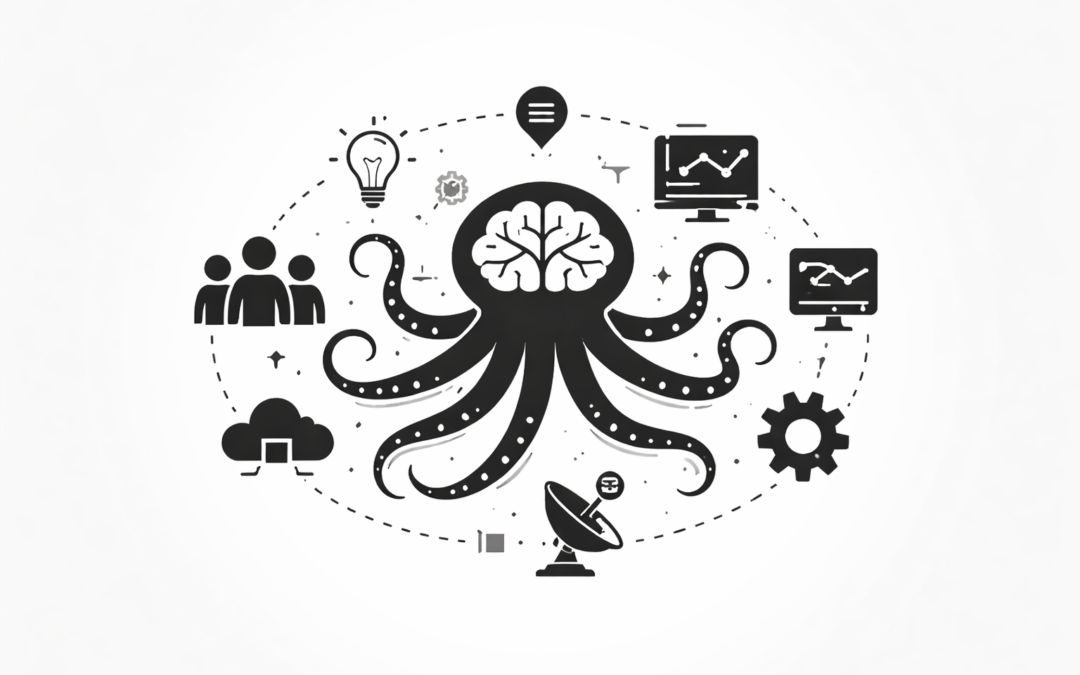
Like an octopus, intelligence is distributed. Each arm senses and acts independently while remaining connected through a shared nervous system. In organizational terms, that suggests empowered teams operating with shared context, real-time information, and minimal hierarchy.
The idea is compelling.
But here’s the uncomfortable question.
Most large organizations today are built for control, reporting lines, and risk containment.
Can systems designed for centralized authority really evolve into networks of distributed intelligence?
Or will the true “octopus organizations” simply be born that way, rather than transformed into them?
I’m looking forward to reading the full book soon , my local library copy is on its way.
About
Mahin Chugh is a seasoned digital-transformation leader with deep experience in solution architecture and strategic account management. His work bridges technology, governance, and business value realization. He has held leadership roles at Oracle, Hewlett Packard, Tata Consultancy Services, and Icertis, delivering large-scale ERP, SaaS, and outsourcing programs across Australia, the Nordics, the UK, India, and the EU. Mahin specializes in aligning CLM/S2P, risk, and data platforms to protect margin and accelerate growth—managing multi-vendor ecosystems and translating strategy into measurable outcomes. He is certified in TOGAF, PRINCE2, and ITIL. Through GSP Strategic Advisors, he helps enterprises design contract-intelligence loops that convert commitments into results; at Nexis Creative, he leads brand-driven initiatives that amplify those results.
Disclaimer
GSP Strategic Advisors strives to provide accurate and reliable information on this website but makes no guarantees regarding its accuracy, completeness, or currency. All content is provided “as is” and may be amended without notice, including details on services and fees. GSP Strategic Advisors is not liable for any loss or damage resulting from the use of this website or reliance on its content. Use of this website is at your own risk. Links to third-party websites are provided for convenience only and do not imply endorsement or approval by GSP Strategic Advisors